Beginner’s Complete Guide · 2026
Dungeons & Dragons for Beginners:
How D&D Actually Works
Everything you need to roll your first die — characters, dice, gameplay loops, and combat explained in plain English.
▶ Watch first, then read on for the deep-dive
So you’ve heard people talk about Dungeons & Dragons — maybe on a podcast, maybe in Stranger Things, maybe because your coworker won’t stop quoting their barbarian’s battle cry. You’re curious, but every time you try to learn, you end up drowning in rulebooks, Reddit arguments, and optimisation guides that assume you already have a PhD in fantasy tabletop.
This guide cuts through all of that. By the end, you’ll understand what D&D is, how it works, what the dice actually do, and how to jump into your first session with confidence — whether you’re the newest adventurer at the table or a Dungeon Master trying to onboard a confused newcomer.
What Is Dungeons & Dragons?
Dungeons & Dragons (D&D) is a tabletop roleplaying game (TTRPG) — think of it as collaborative storytelling with rules. You and a group of friends create characters and guide them through a fantasy world full of monsters, treasure, puzzles, and political intrigue. One person (the Dungeon Master) describes the world; everyone else decides what their characters do inside it.
“Basically it’s play-pretend for adults — your very own Lord of the Rings or Game of Thrones, where you get to decide what happens next.”
— Ginny Di, D&D educator & creator
Unlike a video game, there’s no screen telling you what you can and can’t do. The only limits are your imagination and the dice. You describe what your character attempts — whether that’s intimidating a guard, picking a lock, or leaping across a lava pit — and the dice determine whether it works.
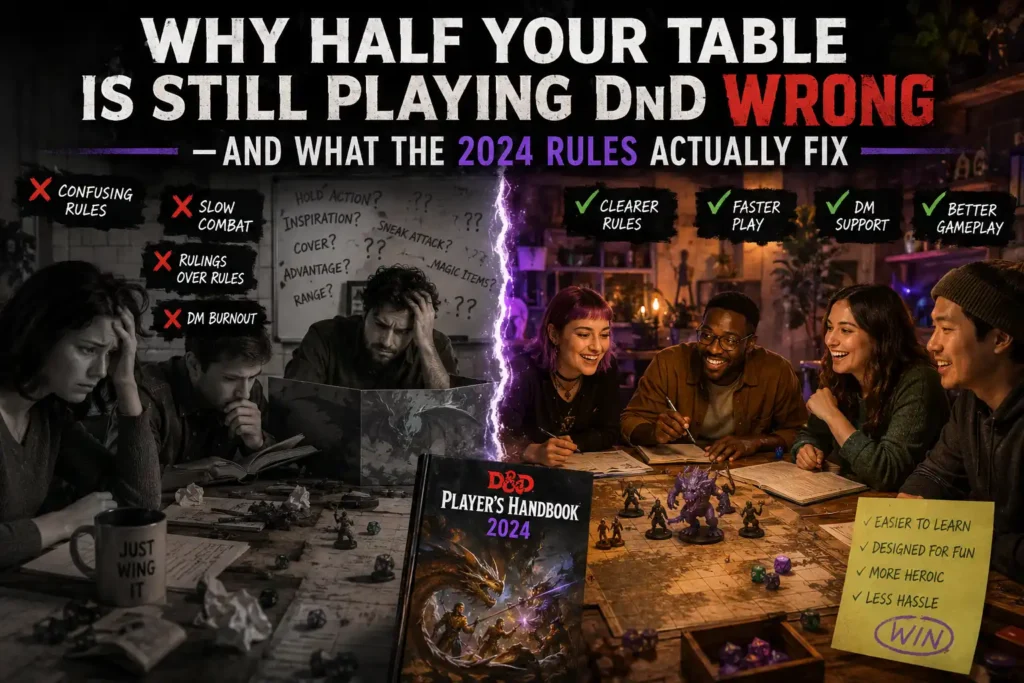
D&D was first published in 1974 and is currently on its 5th Edition (5e), with a major rules update released in 2024 often called “D&D 2024” or the “One D&D” revision. Both versions are widely played and largely compatible.
The Two Roles: Dungeon Master vs. Player
A typical D&D game has one Dungeon Master (DM) and four to six players, though smaller or larger groups work too.
Dungeon Master (DM)
Narrates the world, controls every NPC and monster, sets the scene, and adjudicates the rules. Think of them as the game’s narrator, referee, and improv actor combined. The DM isn’t your enemy — they’re your tour guide.
Player Character (PC)
You step into the shoes of a fictional adventurer — an elf wizard, a human paladin, a halfling rogue — and make choices on their behalf. You can do almost anything you can imagine; just be ready for the consequences.
Roles are typically fixed for a campaign. Nobody “wins” D&D in the traditional sense. The goal is a fun, memorable shared story.
✦ Beginner Tip
If you’re brand new, start as a player, not a DM. Being a DM requires improvisation, world-building, and deep rules knowledge. Playing first lets you absorb the game before you have to run it.
Building Your D&D Character
Before you play, you need a character. All the important information lives on a character sheet — it looks intimidating, but it’s really just a reference document you’ll consult during the game. You don’t memorise it; you look things up as needed.
Species
Human, elf, dwarf, halfling, tiefling, dragonborn, and more. Each species grants unique traits and minor bonuses.
Class
Your adventuring specialty: fighter, wizard, rogue, cleric, barbarian, druid, monk, paladin, and many more. This defines your abilities and playstyle.
Subclass
A specialisation within your class, chosen at level 3. A wizard might specialise in Evocation (blowing things up) or Divination (predicting the future).
Background
Your character’s history before adventuring: soldier, criminal, noble, folk hero. Backgrounds grant skills and add narrative flavour.
Appearance & Personality
What do they look like? How do they talk? What drives them? This is entirely up to your imagination.
Ability Scores
Six numbers measuring your character’s raw capabilities. The most math-y part of D&D — explained simply in the next section.
The most important advice for new players: talk to your DM before creating a character. Different campaigns have wildly different settings — you don’t want to arrive at a nautical pirate campaign playing a landlocked mountain dwarf who gets seasick.
The 6 Ability Scores Explained
Every D&D character has six ability scores ranging from 1 (catastrophically bad) to 20+ (legendary). From each score, a modifier is derived — a small bonus or penalty you add to dice rolls. A score of 10 is dead average, with no bonus or penalty. A score of 16 gives you a +3 modifier.
| Score | Abbr. | Governs | Example Use |
|---|---|---|---|
| Strength | STR | Physical power & melee attacks | Kicking down a door, grappling an enemy |
| Dexterity | DEX | Agility, reflexes & ranged attacks | Picking a lock, sneaking past guards |
| Constitution | CON | Stamina & hit points | Concentration spells, resisting poison |
| Intelligence | INT | Memory, reasoning & arcane magic | Recalling history, solving riddles, wizardry |
| Wisdom | WIS | Perception, insight & divine magic | Noticing a trap, reading someone’s intentions |
| Charisma | CHA | Force of personality & social skills | Persuading a merchant, intimidating a bandit |
⚔ Pro Tip
Don’t try to be good at everything. The most fun characters are specialists — a rogue with maxed Dexterity who can pick any lock, or a barbarian with sky-high Strength who cleaves enemies in one swing. Use a Point Buy Calculator to optimise your stat array.
Understanding D&D Dice
D&D uses a set of seven polyhedral dice, each named after its number of sides. Here’s the full set — hover any die to see it roll!
For 90% of your rolls, you’ll use the d20. It’s the cornerstone of the whole system — every skill check, attack roll, and saving throw starts with a d20.
The Core Roll Formula
- Roll the d20 — announce the number you rolled.
- Add your relevant modifier — e.g., your Strength modifier (+3) for a feat of strength.
- Add your proficiency bonus — if your character is trained in this skill or weapon (starts at +2, scales with level).
- Compare to the target number — called a Difficulty Class (DC) for skill checks, or Armor Class (AC) for attacks. Meet or beat it to succeed.
The other dice mostly appear when rolling damage after a successful attack. A greatsword does 2d6 damage. A dagger does 1d4. A fireball does 8d6. More dice = more damage potential.
✦ Critical Hit!
When you roll a natural 20 on an attack (the d20 lands on 20 before any modifiers), it’s a Critical Hit — you roll your damage dice twice. Roll a natural 1? That’s a Critical Fail — the DM gets creative about how badly things go wrong.
How D&D Gameplay Actually Works
A D&D session is typically 3–4 hours. A series of sessions forms a campaign, which can run for months or years. Here’s what happens at the table:
The DM sets the scene. Unlike a video game, you can’t see your surroundings — the DM describes them verbally. “You enter a dimly lit tavern. A bard is playing an off-key ballad for sparse applause. The barkeep eyes you suspiciously.” Your job is to paint this picture in your imagination.
Players describe their actions. There’s no menu, no button prompt. You simply say what your character does: “I approach the barkeep and ask if he’s heard any rumours lately.”
The DM calls for a roll when needed. If you try to do something with an uncertain outcome — persuade a merchant, leap across a chasm, sneak past a sleeping guard — the DM asks for a check. If the outcome is certain, the DM may not even call for a roll. Common sense is always the first rule of D&D.
“You can do pretty much anything you can think of. Or at least — you can try.“
Three Pillars of D&D Play
Roleplay
Interacting with the world — talking to NPCs, making decisions in character, advancing the story through conversation and choices.
Exploration
Moving through the world — navigating dungeons, discovering locations, solving environmental puzzles, finding hidden secrets.
Combat
Fighting enemies — structured, turn-based encounters with movement, attacks, spells, and tactics. The most rules-heavy pillar.
D&D Combat: Turns, Attacks & Saving Throws
When a fight breaks out, play shifts from freeform narrative into a strict turn-based system.
Step 1: Roll Initiative
Everyone — players and monsters — rolls a d20 and adds their Initiative modifier (usually Dexterity). The DM arranges everyone from highest to lowest. That’s the Initiative Order — the sequence of turns for the entire fight.
Step 2: Take Your Turn
Each turn you get three core options:
Attack Rolls vs. Saving Throws
Attack Roll
The attacker rolls d20 + attack modifier and tries to meet or beat the target’s Armor Class (AC). Used for sword swings, arrow shots, and some spells. Hit? Roll damage.
Saving Throw
The defender rolls d20 + relevant modifier and tries to beat a Difficulty Class (DC) set by the attacker. Used for area spells, poisons, and traps. Fail? Take the effect.
There’s also a fourth option between turns: the Reaction. Once per round, you can react to a specific trigger — the most common being an Opportunity Attack when an enemy tries to walk past you.
✦ New Player Reminder
Don’t try to memorise all your abilities before your first session. Focus on your basic attack and one or two class features. Ask your DM or a fellow player whenever you’re unsure — even veterans check their sheets constantly.
Beginner FAQs
Do I need to buy expensive books to play D&D?
No. Wizards of the Coast offers a free Basic Rules PDF and the D&D Beyond platform has free character creation and rules reference. For your first few sessions, free resources are completely sufficient. If you fall in love with the game, the Player’s Handbook is worth owning.
How many players do you need?
The sweet spot is 4–5 players plus a DM. You can technically play with as few as 2 (one DM, one player) or as many as 8, though very large groups tend to slow down. If you’re struggling to find players locally, Roll20 and Discord are great for finding online groups.
How long does a session last?
A typical session runs 3–4 hours. A one-shot is a self-contained story told in a single session. A campaign can run for months or years of weekly sessions. Most new players start with a one-shot before committing to a long campaign.
What’s the best class for beginners?
The Fighter is widely recommended — its mechanics are straightforward: you hit things and take hits. The Ranger or Paladin offer more flavour while remaining beginner-friendly. Spellcasters like Wizards are more powerful but have more rules to track — save them for your second character.
Do I need to roleplay in a voice or stay in character?
Absolutely not. Deep roleplay is optional. Some players do elaborate voices; others describe actions in the third person and never stay in character. Both are valid. D&D is a broad church — find a playstyle that feels comfortable at your table.
Can I play D&D online?
Yes — many groups play entirely online. Popular platforms include Roll20 (virtual tabletop with maps and dice), Foundry VTT (self-hosted, very powerful), and D&D Beyond (rules reference and character management). Most groups coordinate over Discord for voice.
Free D&D Tools to Power Your Adventure
Our interactive calculators and guides are built for players at every level — from rolling your very first character to optimising a level 20 build.
Dungeons & Dragons can look overwhelming from the outside — all those books, dice, and miniatures. But at its core it’s a simple, joyful loop: the DM describes a world, you decide what your character does, and the dice add delicious uncertainty to the outcome. Everything else is flavour.
The best advice for any new player? Don’t wait until you feel ready. Find a table and roll some dice. No guide, video, or podcast can replicate the actual experience of sharing a story with people who are as invested in the adventure as you are.
⚔ May your rolls be high and your loot plentiful. ⚔