Creating your first D&D character can feel like solving a magic puzzle. Many new players struggle with ability scores and rules, wasting precious game time. You are not alone.
At DnD Stat Calculator, we’ve helped thousands of players build characters fast. Our guides turn confusion into confidence. You will learn how to make a D&D Character (5e) step by step.
We explain ability scores simply. We compare point buy and standard array. We show you how to fill out a character sheet.
By the end, you will have a ready-to-play hero. You will know which method suits your style. Let’s start your adventure.
Understanding D&D 5e Character Creation Basics
Every D&D character starts with six core numbers. These numbers are your ability scores. They define how strong, smart, or charming your hero is.
You choose a race, a class, and a background. Each choice gives you bonuses and special traits.
You also pick skills, equipment, and spells that match your class.
All of these pieces go onto your character sheet.
The sheet is your reference during play.
It tells the Dungeon Master what you can do.
A clear sheet makes gameplay smooth and fun.
How to Make a D&D Character (5e) Using Point Buy
✦ Free D&D Tool ✦
Skip the Character Sheet.
Build Your Hero in Minutes.
Why wrestle with blank sheets when your next legend is a few clicks away? Our step-by-step character creator walks you through every choice — race, class, stats, spells, and backstory — and exports a print-ready sheet when you’re done.
100% free. No account needed. Works on desktop & mobile.
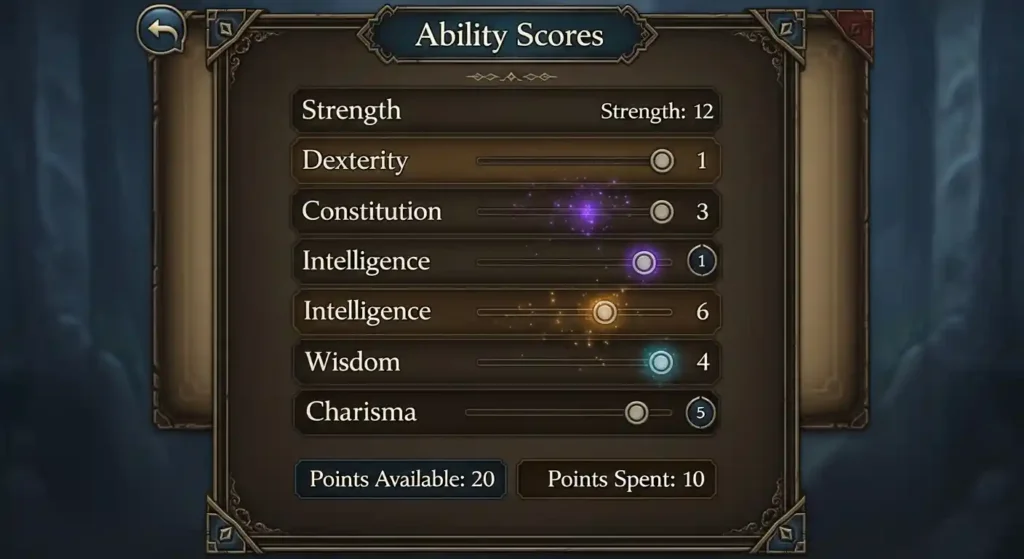
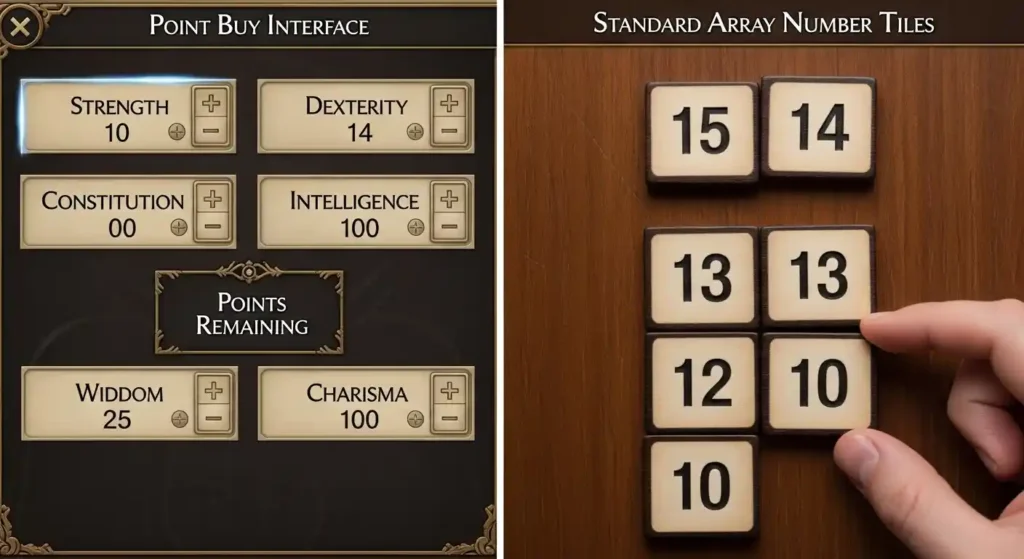
Point buy lets you spend points to raise ability scores. You start with a set number of points, usually 27.
Each score has a cost. Higher scores cost more points.
For example, a score of 15 costs 9 points. A score of 8 costs 0 points.
You distribute points until you run out.
This method gives you full control over your strengths and weaknesses.
You can prioritize the scores that matter most for your class.
A wizard might put many points into Intelligence.
A fighter might focus on Strength and Constitution.
Point buy avoids randomness.
You get the same total power as other players using this method.
💡 PRO TIP: Use our free Point Buy Calculator to see instant results. It shows the cost of each score as you adjust them. This saves time and prevents math errors.
Explaining D&D Ability Scores: Strength, Dexterity, Constitution, Intelligence, Wisdom, Charisma
Strength measures raw physical power. It affects melee damage and carrying capacity.
Dexterity reflects agility and reflexes. It boosts armor class, initiative, and ranged attacks.
Constitution represents health and stamina. It determines hit points and resistance to fatigue.
Intelligence gauges reasoning and memory. It influences spellcasting for wizards and skill checks.
Wisdom covers perception and intuition. It powers cleric and druid spells and insight checks.
Charisma reflects presence and leadership. It governs bard, paladin, and sorcerer spells and social interactions.
Each score starts at 8 before racial bonuses.
You raise scores using point buy or standard array.
Then you add racial modifiers.
For example, a hill dwarf adds +2 Constitution and +1 Wisdom.
Your final scores shape every roll you make.
⚠️ WARNING: Do not dump points into a score your class never uses. A wizard with high Strength but low Intelligence will struggle to cast spells effectively.
D&D Beyond Ability Scores Guide

Point Buy vs Standard Array: Which Should You Choose?
Point buy gives you flexibility to tailor scores to your concept.
Standard array provides a fixed set of numbers: 15, 14, 13, 12, 10, 8.
You assign these six numbers to your six abilities in any order.
What Is Point Buy?
Point buy uses a pool of points to buy scores.
You decide exactly how high each score goes.
This method rewards planning and optimization.
What Is Standard Array?
Standard array offers simplicity and balance.
Everyone starts with the same total power.
No math is needed beyond assigning numbers.
When to Use Each Method
Choose point buy if you want a specific build, like a charismatic bard with high Dexterity.
Choose standard array if you prefer quick setup and equal footing with other players.
Many new players find standard array less intimidating.
Experienced players often prefer point buy for fine-tuning.
Your DM may allow only one method.
Check your group’s house rules before deciding.
📌 QUICK FACT: The standard array totals 72 points before racial bonuses, the same as a 27-point buy after adjustments.
Filling Out Your D&D Character Sheet Guide
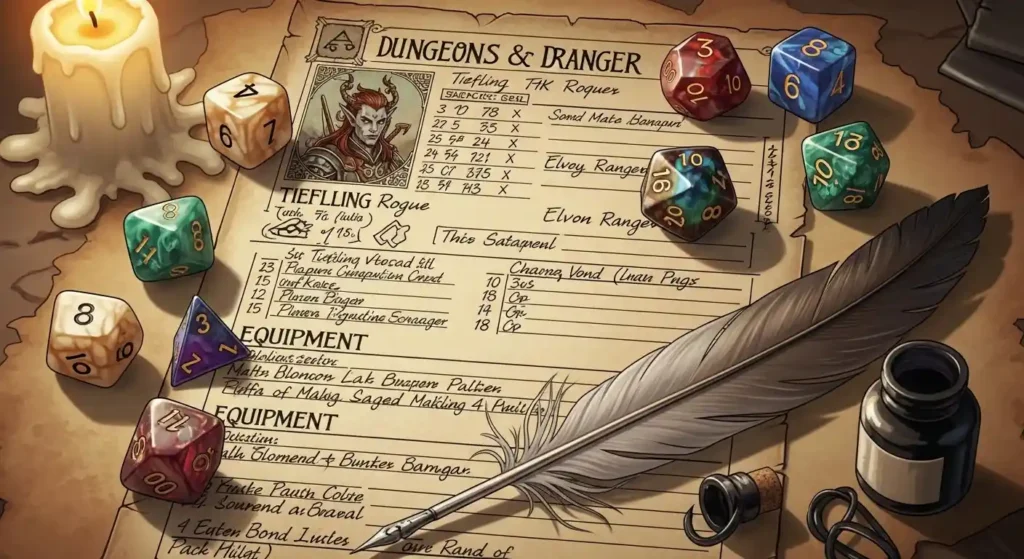
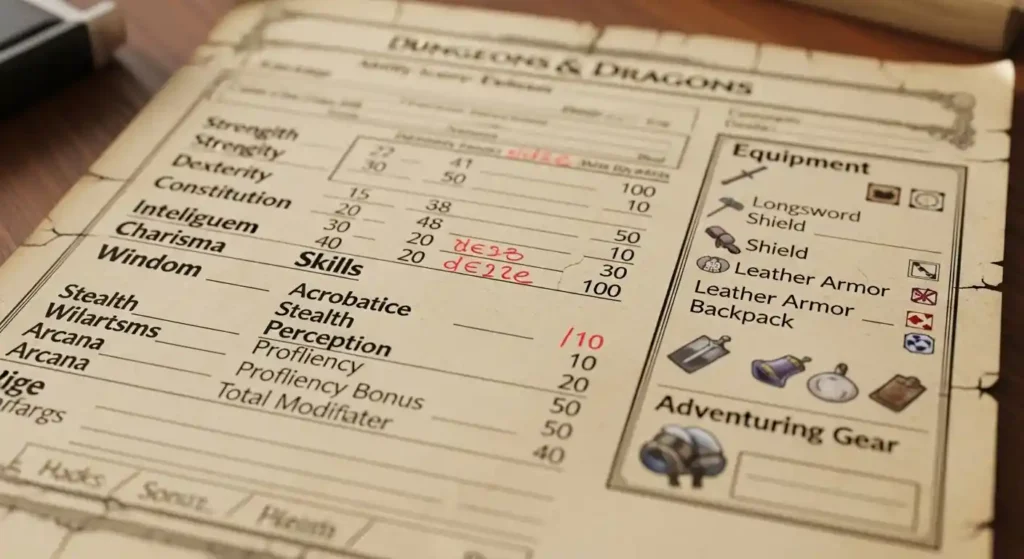
Your character sheet has several key sections.
Start with ability scores at the top left.
Write each score and its modifier.
The modifier is (score – 10) ÷ 2, rounded down.
For example, a score of 14 gives a +2 modifier.
Ability Scores Section
List Strength, Dexterity, Constitution, Intelligence, Wisdom, Charisma.
Add racial bonuses to each base score.
Calculate the final modifier for each.
Double-check your math.
Skills and Proficiencies
Mark skills you are proficient in.
Your class and background give you skill proficiencies.
Add your ability modifier plus proficiency bonus if skilled.
If not skilled, add only the ability modifier.
Equipment and Spells
List weapons, armor, and gear from your class and background.
Note gold pieces remaining.
Spellcasters write known spells and spell slots.
Update this section after each level.
Bringing Your Character to Life: Background, Class, and Race
Race grants unique traits like darkvision or extra language.
Class defines your role in combat and magic.
Background adds story flavor and extra skills.
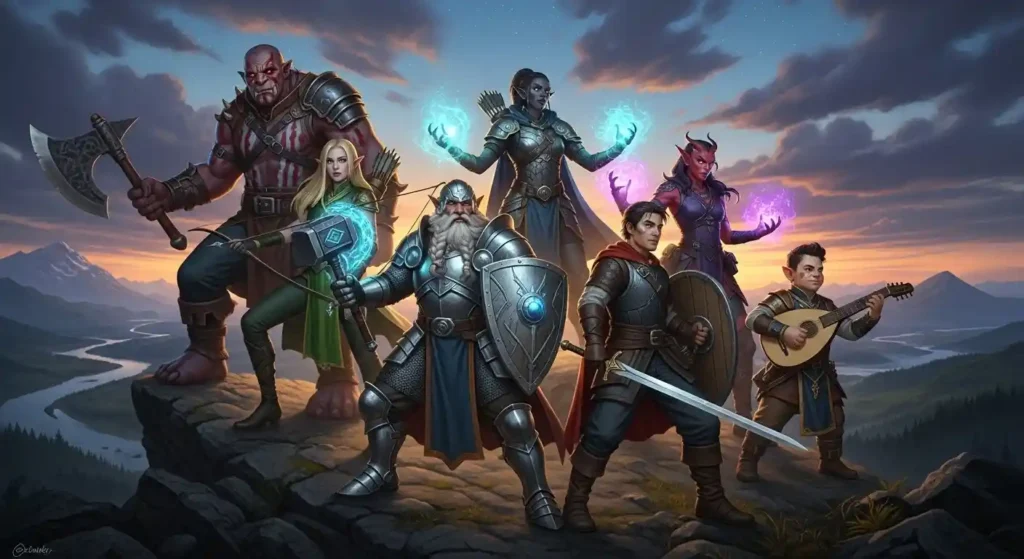
Combine these elements to create a cohesive hero.
Think about your character’s personality and goals.
Ask yourself why they adventure.
What do they fear?
What do they desire?
Answering these questions helps you role-play at the table.
Talk with your DM about how your backstory fits the campaign.
A well-integrated character enriches the story for everyone.
Frequently Asked Questions
How to Make a D&D Character (5e) for the first time?
What is the best method for ability scores: point buy or standard array?
How do I calculate ability score modifiers?
Can I change my character’s abilities after creation?
Where can I find official rules for character creation?
How many points do I get in point buy?
Do I need to buy expensive books to make a character?
How does my race affect my ability scores?
Remember these three takeaways: choose a method that fits your style, calculate modifiers correctly, and integrate race, class, and background into a cohesive story. You now know how to make a D&D Character (5e) using simple steps and free tools.
Start building your hero today with our Point Buy Calculator and bring your imagination to the table.
🎲 FREE TOOL: Point Buy Calculator — Instantly distribute your ability scores without the math. Try it free →